

The quest for a calm mind can feel like chasing a mirage in the modern world. We live in an era characterized by chronic overstimulation, decision fatigue, and relentless stress. Most adults look for ways to decrease internal anxiety, optimize their mental performance, and create a better life. Yet, traditional relaxation techniques often provide only temporary relief because they miss the foundational neurobiology of human peace.
True personal growth does not come from turning off your thoughts or escaping reality. Instead, it stems from changing how your brain processes reality.
Your brain is divided into two distinct hemispheres: the left brain and the right brain. When these two hemispheres operate in isolation, mental fatigue, emotional reactivity, and persistent stress follow. However, when you learn to synchronize both sides of the human brain together, you unlock a state of profound mental clarity known as whole-brain integration.
By understanding the dual nature of your neurology and practicing targeted integration techniques, you can build a sustainable foundation for mental wellness. This article explores the science of hemispheres, details how to master whole-brain synchronization, and provides a clear framework for anyone wanting to expand their mind and experience lasting peace.
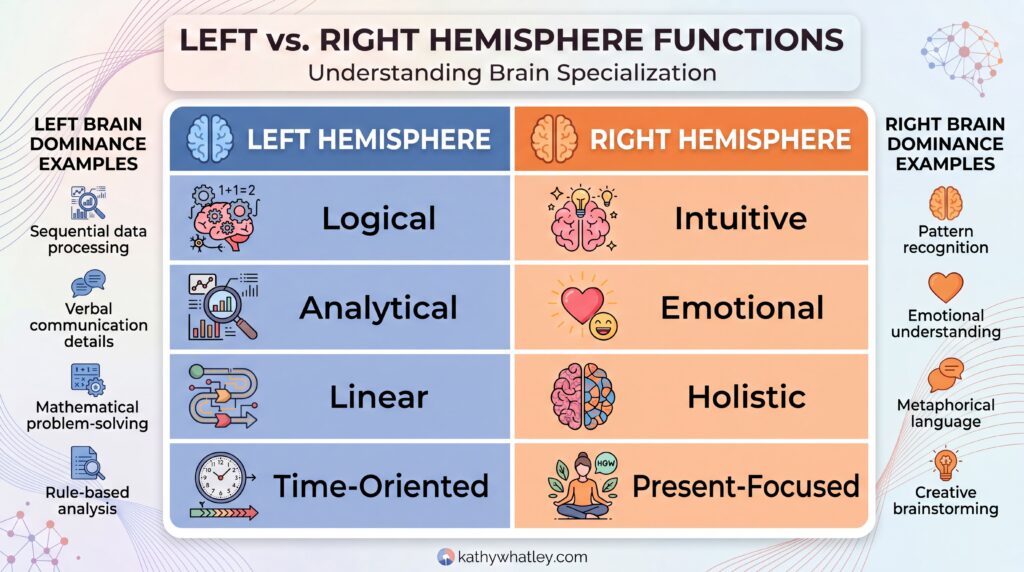
1. The Tale of Two Hemispheres: Understanding Your Brain’s Internal Divide To build a calm mind, you must understand the dual nature of your internal hardware. Your left and right hemispheres process the world through completely different lenses, serving as two unique processing centers inside a single skull.
The Analytical Left Brain
The left hemisphere is your inner architect. It is logical, analytical, linear, and deeply time-oriented. It handles language, mathematics, structural reasoning, and cause-and-effect planning.
When you organize your calendar, calculate a budget, or build a strategic business plan, your left brain dominates. It craves order, predictability, and control. It breaks the world down into tiny, manageable pieces so that you can categorize, label, and manipulate data. Without the left brain, human beings could not build cities, write code, or plan for the future.
The Experiential Right Brain
The right hemisphere is your inner artist. It is intuitive, emotional, creative, and holistic. The right brain does not process time linearly; it lives entirely in the present moment.
It reads facial expressions, processes musical rhythm, understands metaphors, and senses spatial relationships. When you feel a sudden wave of awe looking at a landscape or experience a flash of gut intuition, your right brain is leading the way. It looks at the big picture, recognizing patterns and connections that logic misses entirely.
The Conflict of Hemispheric Dominance
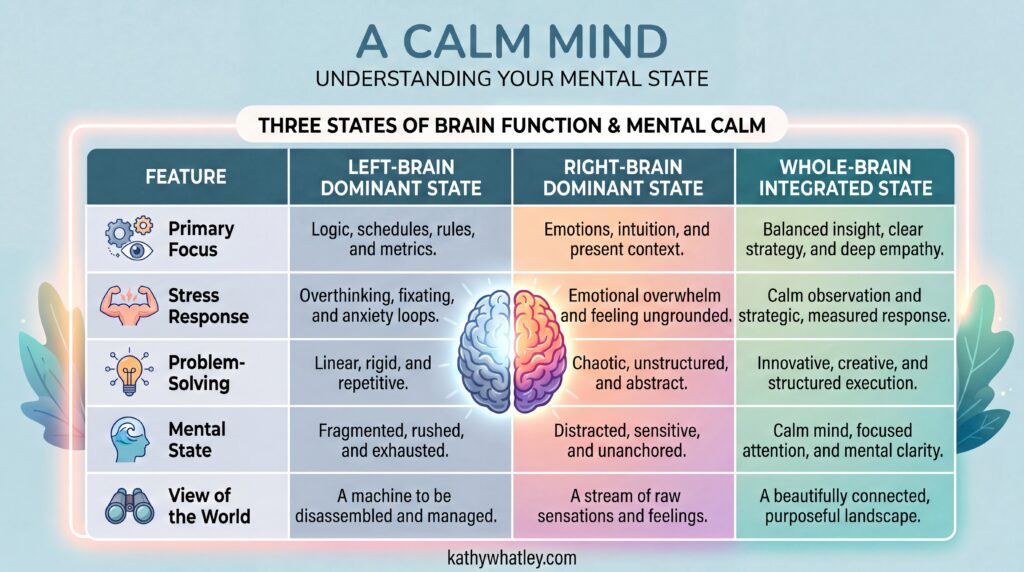
Modern society is heavily biased toward left-brain attributes. We reward speed, metrics, structural productivity, and relentless logic. When your left brain runs on overdrive without the balancing input of your right brain, it spins out into an anxious loop of overthinking, anticipation, and worry.
Conversely, if you operate solely from your right brain without left-brain structure, you can become overwhelmed by emotional turbulence, lack direction, and struggle to manifest your goals. True power lies in balance.
2. What is Whole-Brain Integration?
A calm mind is not a blank mind. It is an integrated mind. Whole-brain integration occurs when the left and right hemispheres communicate seamlessly across the corpus callosum—the dense bridge of neural fibers connecting the two halves of your brain.
When your brain achieves this state of balance, it stops wasting metabolic energy on internal friction. Instead of your logical side fighting your emotional side, the two collaborate.
Whole-brain synchronization shifts your neural architecture from a state of reactive survival to a state of purposeful expansion. This neuro-cognitive state is essential for anyone who wants to consciously expand their mind and build a more fulfilling life. When both sides work together, logic grounds emotion, and intuition illuminates logic.
3. The Science of a Calm Mind: Neuroplasticity and Hemispheric Synchronization
For decades, scientists believed that the adult brain was fixed. We now know that your brain possesses neuroplasticity which isthe lifelong ability to reorganize itself, forge new neural pathways, and alter its physical architecture based on behavior and focus. This means a scattered, anxious mind is not a permanent identity; it is a neurological habit that can be rewired.
Shifting Brainwave States
When the hemispheres are disconnected and stressed, the brain primarily produces high-frequency Beta brainwaves. This state is useful for short-term survival but destructive when sustained.
By practicing whole-brain synchronization, you intentionally steer your neural activity into Alpha and Theta brainwave states. These slower, synchronized frequencies are associated with:
- Deep relaxation and stress reduction.
- Enhanced creative problem-solving.
- Accelerated learning and memory retention.
- Heightened emotional intelligence.
By intentionally bridging the two hemispheres, you use your brain’s innate neuroplasticity to hardwire a default state of calm into your nervous system, turning peace into a permanent physical trait.
4. How Hemispheric Misalignment Fuels Stress and Anxiety
When the connection between your left and right brain degrades, your mental health and cognitive capabilities suffer. Let’s look at how hemispheric misalignment creates chronic stress:
The Left-Brain Anxiety Loop
When the left brain feels isolated from the right brain’s grounding presence, its analytical power turns inward. It begins to catastrophize, endlessly analyzing past mistakes or inventing hypothetical future threats. Because it is time-oriented, it drags you out of the present moment and into a future full of worry. This results in mental exhaustion, insomnia, and chronic anxiety.
The Right-Brain Emotional Flood
Without the structural, organizing influence of the left brain, the right brain can become trapped in raw emotion. A minor setback can feel like an existential crisis because the brain lacks the logical framework needed to contextualize the event. You become highly reactive to your environment, swept away by every passing mood.
By intentionally practicing whole-brain communication, you interrupt these isolating cycles. You give your logical brain access to right-brain peace, and your emotional brain access to left-brain perspective.
5. The Root Causes of Modern Neuro-Fragmentation
To fix a fragmented mind, we must understand how it got that way. Modern lifestyles are practically designed to sever the connection between the left and right brain. Identifying these culprits helps you protect your cognitive health.
Hyper-Specialization and the Hustle Culture
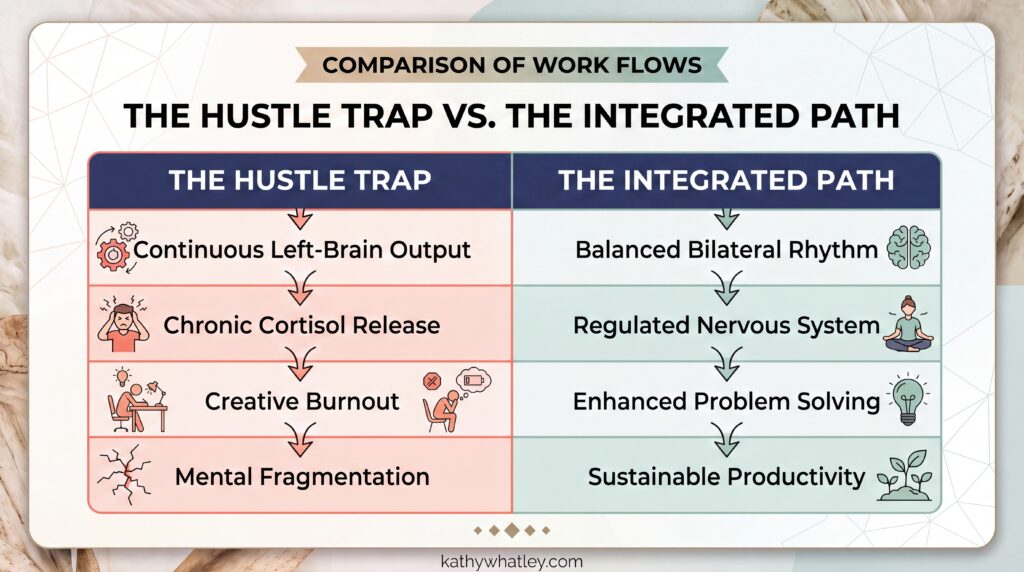
We live in a world that demands specialized, linear performance. From corporate metrics to digital algorithms, adults are conditioned to view life through spreadsheets, schedules, and targets. This constant pressure keeps the left brain locked in high-beta survival mode, while the creative, holistic right brain is starved of stimulation. Over time, the neural pathways connecting the two halves weaken from disuse.
Information Overload and Constant Scannability
The human brain was not evolved to process thousands of fragments of information every hour. Scrolling through social media feeds, reading disjointed news headlines, and jumping between text messages forces the brain into a frantic, superficial state of processing. This shatters your attention span and prevents the deep, integrated thinking that occurs when both hemispheres collaborate on a single concept.
6. Whole-Brain Exercises to Synchronize Your Mind
Achieving whole-brain integration is a skill you can cultivate with targeted neural exercises. These simple, daily practices are designed to force both hemispheres to coordinate, triggering rapid synchronization and mental relief.
Dual-Task Neuro-Integration
Engaging in activities that require simultaneous analytical and creative processing forces your hemispheres to cooperate.
- The Process: Try solving a logical puzzle while listening to complex, instrumental music, or practice a creative craft (like sketching, architectural drafting, or knitting) that requires precise, geometric repetition.
- The Result: This forces the left hemisphere (pattern recognition, structure) and right hemisphere (spatial awareness, creativity) to exchange information rapidly across the corpus callosum.
Cross-Lateral Physical Movements
Physical movements that cross the midline of your body require both hemispheres to fire symmetrically to coordinate action.
- The Process: Engage in intentional bilateral activities like walking with an exaggerated arm swing, yoga twists, or practicing the “Cross Crawl” (touching your right hand to your left knee, then your left hand to your right knee).
The Result: These patterns stimulate the motor cortex across both hemispheres simultaneously, breaking up stagnant mental loops and lowering emotional reactivity.
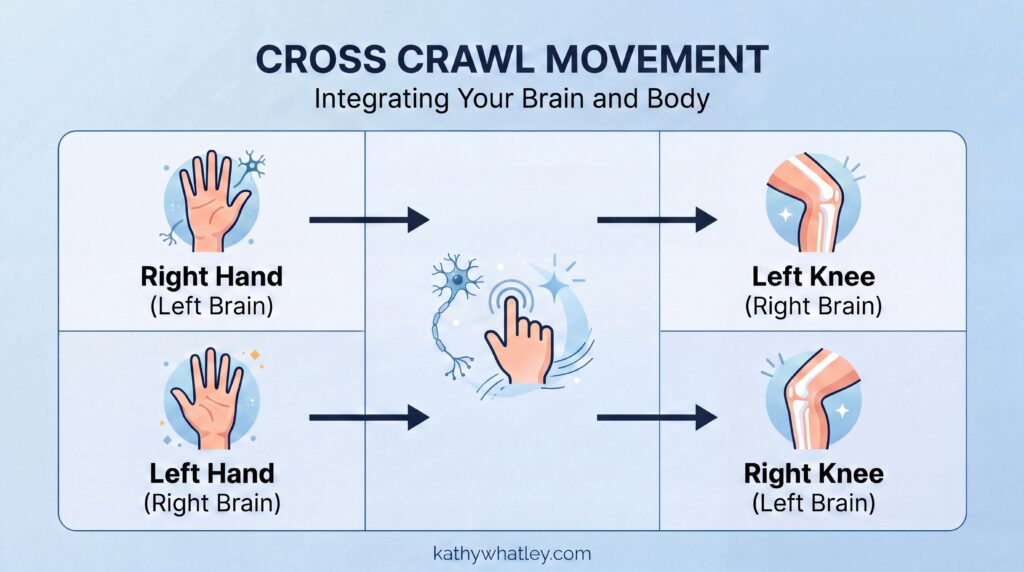
Forces rapid bilateral communication across the midline
Alternate Nostril Breathing (Nadi Shodhana)
This ancient breath technique has a direct, measurable impact on your autonomic nervous system and hemispheric dominance.
- The Process: Close your right nostril with your thumb and inhale deeply through the left. Close the left nostril with your ring finger, release the right, and exhale. Inhale through the right, switch, and exhale through the left.
- The Result: Studies show this practice balances air intake and alternates stimulation between the left and right hemispheres of the brain, inducing rapid biological calm and lowering blood pressure.
Bilateral Auditory Stimulation
Bilateral audio utilizes sound frequencies that move softly between the left and right ears, guiding your brain waves into harmony.
- The Process: Put on stereo headphones and listen to validated bilateral relaxation tracks, ambient nature recordings, or binaural beats designed for alpha-wave entrainment.
- The Result: Your auditory cortex is forced to pass signals back and forth between hemispheres, soothing an overactive amygdala and restoring systemic calm within minutes.
7. Expanding Your Mind: Cognitive Reframing for Personal Growth
Expanding your mind requires more than just biological calibration; it demands a shift in your psychological framework. Cognitive reframing is a whole-brain approach to personal growth that rewrites limiting beliefs.
When you face a major challenge or failure, your left brain registers the objective facts and structural limitations, while your right brain registers the emotional undercurrents and intuitive meaning. An unintegrated brain accepts a negative narrative: “I failed, and this will never change.”
An integrated brain reframes the event by blending both perspectives:
- Left Brain Action: Analytically breaks down the failure to find tangible data, objective lessons, and a step-by-step recovery plan.
- Right Brain Action: Softens the blow with self-compassion, viewing the experience as a single point in a broader lifelong journey of self-discovery.
This integrated approach prevents you from spiraling into self-criticism, allowing you to use life’s challenges as fuel for a better life.
8. The Blueprint for a Better Life: Daily Habits for Long-Term Mental Balance
To solidify whole-brain integration and maintain a calm mind, you need to build daily habits that nourish both hemispheres. True lifestyle balance is built on a foundation of holistic wellness.
Morning Integration Routine
Start your day before the digital world hijacks your attention. Spend five minutes tracking your daily goals, priorities, and schedules in a journal (left brain), followed by five minutes of silent, breath-focused meditation or mindfulness (right brain). This simple sequence primes both hemispheres to collaborate before your workday begins.
Mindful Media Consumption
The modern digital landscape is a left-brain trap of endless metrics, headlines, and notifications. Protect your attention by scheduling tech-free blocks of time every single day. Replace scrolling with unstructured right-brain activities like walking in nature without a destination, listening to music, or free-form drawing.
Brain-Healthy Nutrition
Your brain requires clean, dense fuel to maintain high-level hemispheric communication. Ensure your diet includes:
- Omega-3 Fatty Acids: Found in walnuts, flaxseeds, chia seeds, and wild-caught fish, these fats are vital for maintaining myelin sheath health and swift neural transmission.
- Antioxidant-Rich Whole Foods: Blueberries, dark leafy greens, and cruciferous vegetables protect your brain cells from oxidative stress and inflammation.
- Hydration: Even mild dehydration drops your cognitive processing speed, limits corpus callosum efficiency, and triggers systemic anxiety.
9. Overcoming the “Hustle” Trap: Reclaiming Unstructured Time One of the greatest obstacles to a calm mind is the cultural conditioning that equates your personal worth with your daily productivity output. To truly expand your mind, you must learn to step off the hamster wheel of constant action.
The Value of “White Space”
White space is time on your calendar that has absolutely no agenda. It is not for self-improvement, it is not for exercise metrics, and it is not for catching up on chores. For the left brain, unprogrammed time feels terrifying; it views it as a waste of resources.
However, for the right brain, white space is oxygen. It is during these periods of unstructured downtime that your brain consolidates memories, processes emotions, and makes creative breakthroughs.
Learning to Be, Not Just Do
To create a better life, you must balance your “doing” mode with your “being” mode. Doing mode is linear, aggressive, and goal-oriented. Being mode is receptive, present, and observant.
When you spend an afternoon gardening, sitting quietly by a window, or playing an instrument without trying to perfect a song, you switch into being mode. This rebalances your nervous system and allows your left brain to rest and recover.
10. The Long-Term Benefits of Whole-Brain Living
Commitment to whole-brain integration changes more than just your daily mood; it alters the entire trajectory of your life. When you consistently practice bringing both sides of your brain together, you experience systemic shifts in your health and well-being.
Accelerated Learning and Cognitive Longevity
An integrated brain is highly efficient. Because information flows freely across the corpus callosum, you can learn new skills faster, retain information longer, and synthesize complex ideas with ease. Furthermore, maintaining strong bilateral communication builds a robust cognitive reserve, protecting your mind against age-related decline as you grow older.
Emotional Resilience and Healthier Relationships
When you operate from a whole-brain perspective, you are no longer at the mercy of emotional storms or cold, clinical detachment. You gain the ability to stay grounded in the middle of a crisis.
This emotional stability directly improves your relationships. You can listen to loved ones with deep right-brain empathy while using lef t-brain logic to help them navigate practical challenges calmly.
Direct Comparison: Left-Brain vs. Right-Brain vs. Whole-Brain States
Conclusion: Step Into Your Whole-Brain Potential
Cultivating a calm mind is not about escaping reality, silencing your thoughts, or suppressing your drive to succeed. It is about training both sides of your brain to work as a unified, harmonious team. By blending left-brain structure with right-brain presence, you put an end to chronic overthinking, drastically reduce stress, and build an intentional, balanced life.
Your brain possesses an incredible, lifelong capacity for change. It is an organ designed for growth, adaptation, and transformation. By practicing cross-lateral movements, mindful breathing, and deliberate integration exercises every day, you reshape your neural pathways from the ground up. Stop letting your hemispheres fight for control. Synchronize your mind, expand your potential, and design a life rooted in clarity, peace, and purpose.